Machine learning for a smart vegetable garden
La Paz. Deep Learning. 2021 We all know the importance of plants and many people would like to have plants at home, but there are several problems that prevent this, such as the time available to take care of them.…
A learning project shared by the community. The article documents its team, methods and results; it does not establish that the prototype is ready for real-world use.
La Paz. Deep Learning. 2021
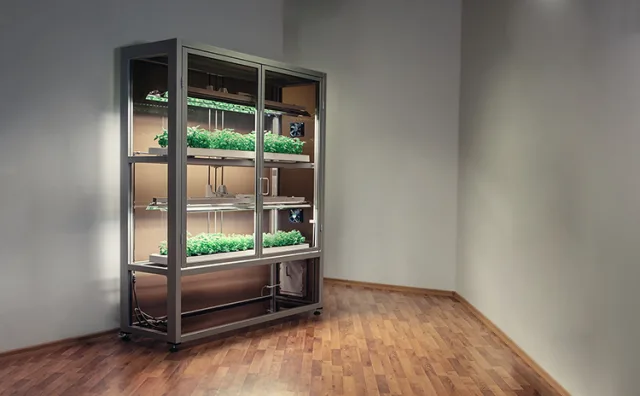
We all know the importance of plants and many people would like to have plants at home, but there are several problems that prevent this, such as the time available to take care of them. This project aims to solve these problems through Machine Learning by creating an intelligent garden that recognizes which plant it is going to care for and applies an appropriate care protocol. The technologies used are convolutional neural networks, computer vision, python and arduino.
Plants are an important part of our daily lives and we do not realize their importance. Plants at home come with many advantages such as reducing air pollution, reducing stress, and reducing noise pollution. But, with so many advantages, why don't we all have plants at home?
This happens because there are some problems when it comes to having plants at home. The three main problems are: Lack of knowledge, carelessness and lack of time. The project consists of a smart garden for the homes of people who want to have plants at home. The garden would recognize the plant it is going to care for through artificial vision and convolutional neural networks and apply an appropriate protocol for the plant. Thanks to this, anyone will be able to have plants at home without having the time or knowledge that this entails.
TECHNOLOGY USED
- cnn
- Python computer vision
- Arduino
- Own dataset
The model used to create the smart garden applying Machine Learning is a YOLOv5 network which is modified to accept the classes of our dataset. For now the dataset only has seven classes (types of plants) due to the time involved in creating a dataset, even so, acceptable performance was achieved. The code was made in Jupyter and the dataset on the Roboflow website.
OPERATION
The garden, through a camera, collects the image of the plant that is processed through convolutional neural networks and artificial vision to obtain a prediction of which plant is in the garden. Afterwards, this prediction causes a signal to be sent, depending on the plant that was identified, to an Arduino which, upon receiving this signal, selects the care protocol depending on the type of plant and thus controls the watering times and the amount of water.
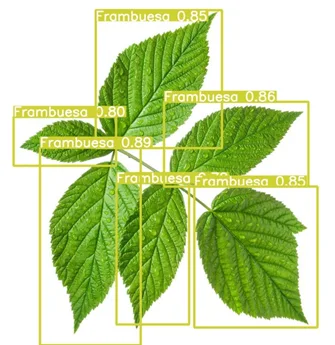
Figure 2. Raspberry Detection
OBSERVATIONS
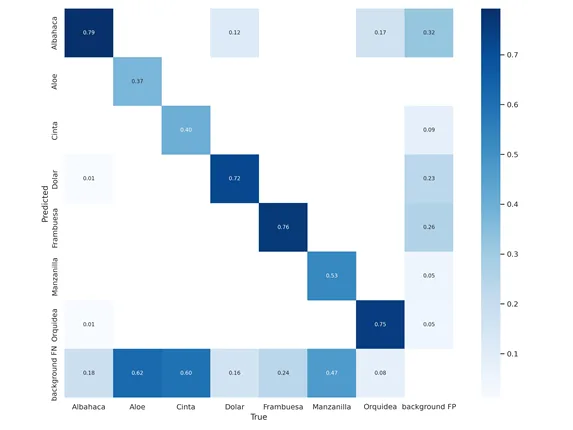
Figure 3. Confusion matrix
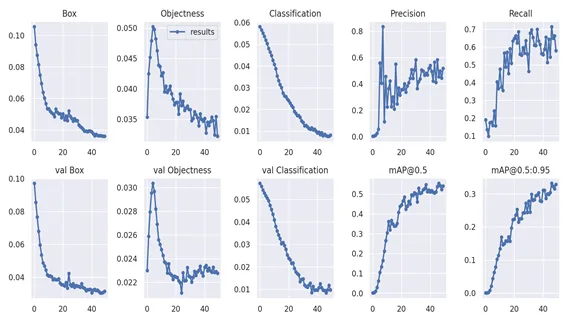
Figure 4. Results
After training, the team obtained a precision of 0.52. It observed confusion between aloe and spider plants, possibly because of similar leaves and limited image data. Tests with other plants, such as orchids and raspberries, were more satisfactory. These results highlight the need for more data and further model evaluation.
NEXT STEPS
Currently, the improvement of the dataset is continuing to obtain more images so that the garden can recognize a greater number of plants and with greater precision. They are also experimenting with different deep learning models to improve the operation of the garden.
The structure is planned to be greatly improved to have a more aesthetic and comfortable design for people's homes in the urban area. In addition, it is planned to improve the hardware part to minimize production costs and control more external factors such as temperature and light.
Finally, it is hoped to be able to implement a version of the garden for large-scale crops.
Project presentation: DemoDay
More artificial intelligence!
Saturdays.AI makes AI more accessible through shared learning and projects with a social purpose. Our motto is AI4ALL IS AI4GOOD.
Meet the Saturdays.AI community
Saturdays.AI
Written by
Kenneth Bonilla
Saturdays.AI
Saturdays.AI is an open community for learning artificial intelligence, collaborating and building projects with social impact.
A story from the Saturdays.AI community. Originally published on Jan 2, 2022.
← More community stories