
Saturdays.AI Master programme
This page includes programme information from our community archive. Contact the team to confirm current dates, availability and requirements.
Your next step in artificial intelligence
Learning AI means connecting knowledge with practice: understanding data, experimenting with models and building projects that address real needs. Saturdays.AI helps you find resources and a community to learn with.
This page preserves the Saturdays.AI Master programme published on our previous website. It is an independent training programme, not an accredited university master’s degree. Ask the team about its availability and current options before enrolling.
Ask about upcoming editions | Explore learning resources
Archive of previous editions
- 100% online
- 12 months
- At your pace
Saturdays.AI Master programme
Learn together and build with purpose. #ai4all #ai4good
A community connecting people from more than ten countries to learn AI and build projects with social impact. 🚀
The original programme had two tracks, machine learning and deep learning, with a preparation module for beginners and optional specialisations in AIoT, large language models (LLMs), generative AI and other areas.

The programme brought together people starting out in AI and professionals from other fields. Fellow learners, mentors and practical challenges supported the learning process.
Develop programming, machine learning and data analysis skills while creating a social impact project ✊
What will you do inside?
Create a project in 12 months
Learn the foundations of machine learning and deep learning.
The programme culminated in a project with social impact, supported by experienced mentors.
Acquire practical skills.
Recorded classes, explanations, challenges and feedback from fellow learners help you learn by doing.
Connect with people like you
The original programme connected more than 200 people interested in AI from cities around the world.
Don't learn alone.
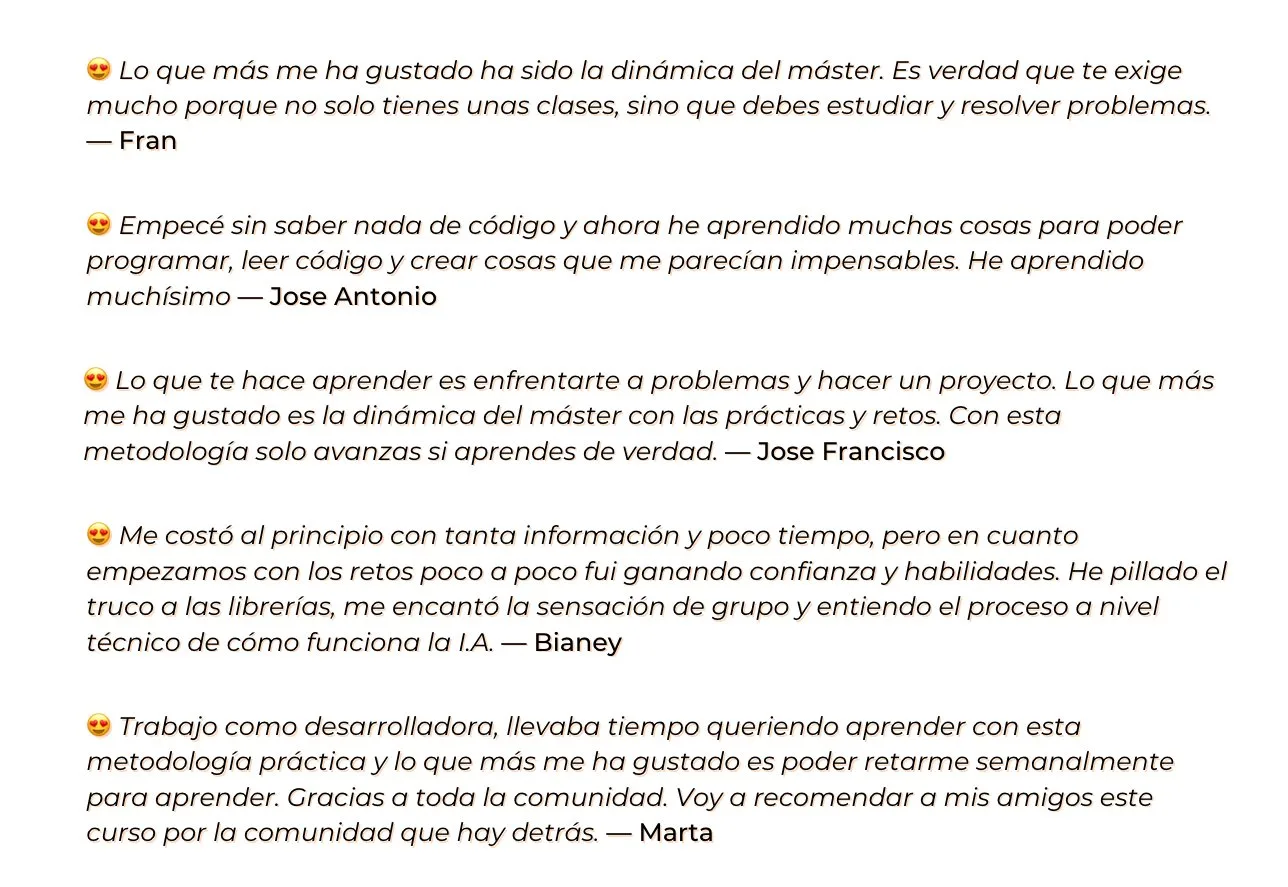
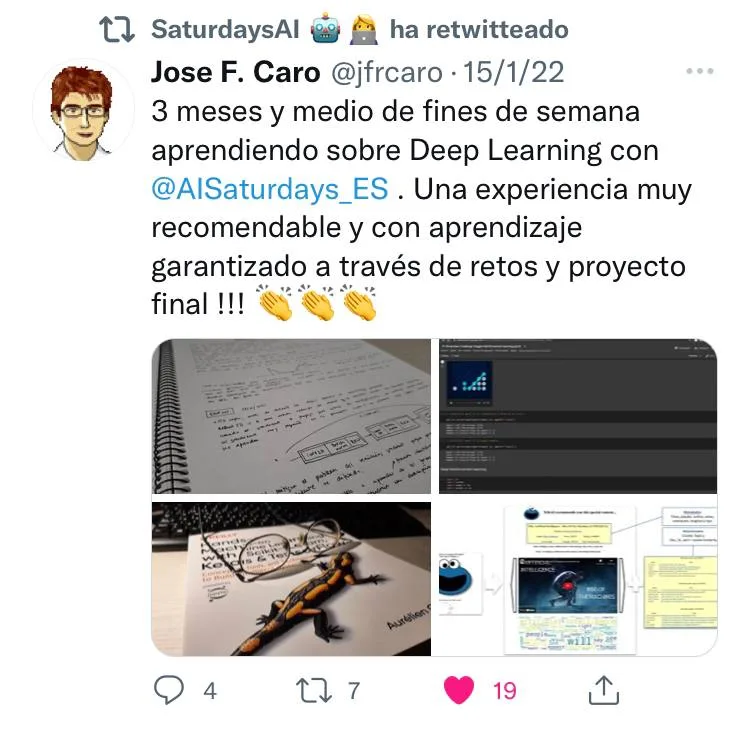
What do they say?
Here are some experiences that participants have shared publicly.
Online learning with support
1. Preparation to get started
2. Experienced mentors
The original programme included 70 hours of content per specialisation: recorded videos, exercises and solutions.
3. Practical exercises
Each module includes exercises that, in addition to summarizing the key concepts of each topic, help you learn by doing.
4. Community support
The program includes private forums to ask questions, practise coding and connect with mentors and fellow learners.
5. Projects
To complete the programme, each participant developed and presented a project with social impact, supported by mentors.
6. Diploma
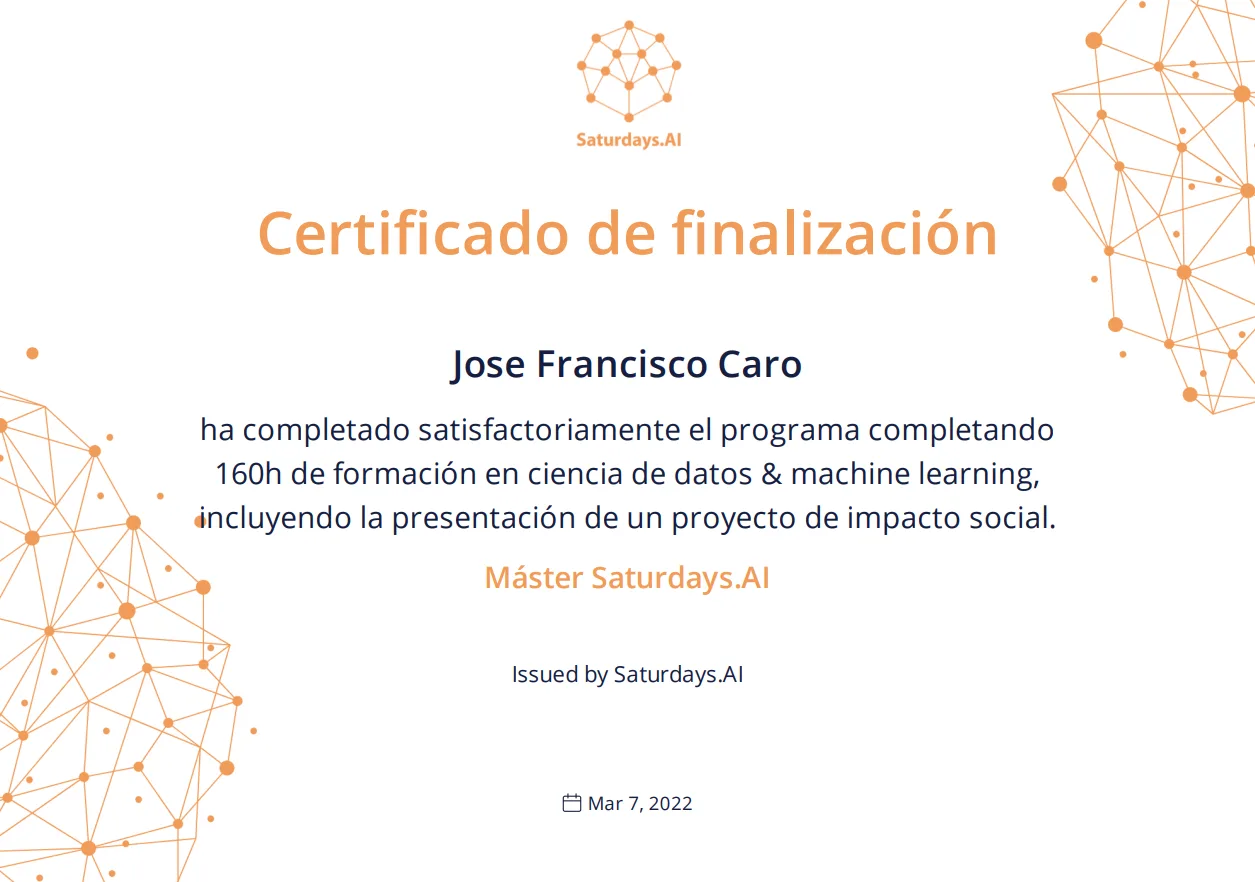
The programme included a diploma for participants who completed the challenges and final project in each track.
Explore the programme 👇
🤖 Our Mission 🚀
We are a community with a mission to make AI accessible to everyone.
Learning for the future increasingly takes place in communities. We connect a global community 🌎 of AI students
What makes us different…

Javi Ramirez
Digital creator and founder of PromptHero
“… Saturdays.AI makes artificial intelligence easier to approach by opening it up beyond engineers and mathematicians, enabling many more people to build projects with support from mentors and the community.”

Irene Font
Director of Trusted AI at Liberty Mutual at the time of this edition

Nora Lama
Strategic Partner Manager at Google at the time of this edition
"What improved my knowledge the most was the methodology of learning by doing. It doesn't matter how much experience you have..."
Saturdays.AI has supported more than 30,000 fellows in learning AI and developing their skills.












Learning programming and data analysis can broaden your career options and help you develop your own projects.
Join us and learn AI
Learn by building
The original programme combined study materials, an AI tutor, practical training, support and a final project. Ask the team which resources and forms of support are currently available.
A comprehensive learning programme 👨💻
I am getting started in AI
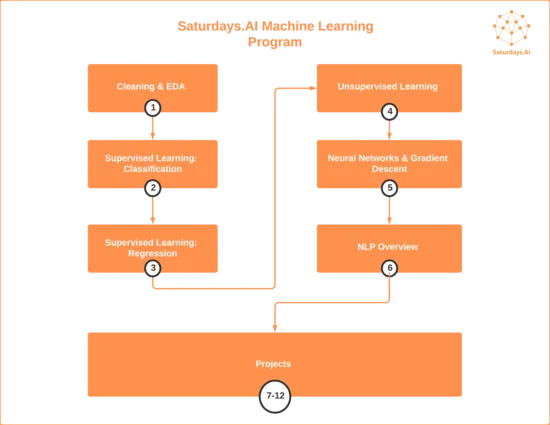
Machine learning track
This track combines explanations and exercises to build practical understanding of machine learning and data science.
6 Modules + Project
160 Hours
1. Exploratory data analysis
- Introduction to machine learning and its applications
- Data cleaning and splitting into training, validation and test sets
- Data types: tabular data, time series, structured and unstructured data
- Preprocessing, visualisation and exploratory data analysis
- Basic models: k-NN and decision trees
2. Supervised learning: classification
- Decision trees
- Random Forest
- Hyperparameter tuning
- Validation of classification models
3. Supervised learning: regression
- Overfitting and underfitting
- Bias and variance
- Regression
- Cross-validation
- Validation of regression models
4. Unsupervised learning
- Clustering with k-means
- Dimensionality reduction: PCA and t-SNE
- Hierarchical clustering
- Elbow method and explained variance
5. Neural networks and gradient descent
- Introduction to neural networks (NN)
- Gradient Descent
- Backpropagation
- Transfer learning
- Model evaluation metrics
6. Natural language processing (NLP)
- NLP Basics
- NLP workflow
- Regular expressions and word tokenisation
- Named entity recognition (NER)
- Feature engineering
I already have previous experience and I want to go further.
Deep learning track
Study the principles of deep learning and apply them to practical challenges and exercises to develop your skills.
6 Modules + Project
160 Hours
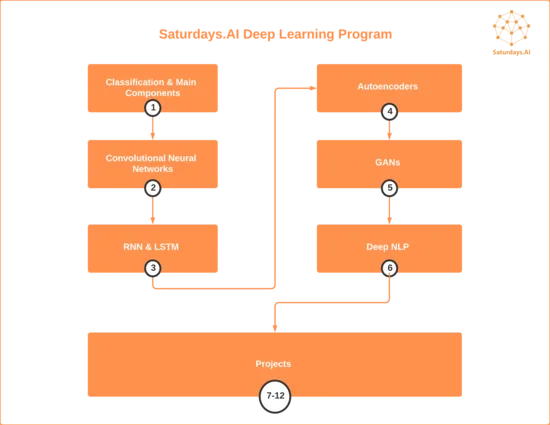
1. Classification and main components
- Basic exploratory data analysis
- The neuron and its activation functions (the perceptron)
- Neural networks (NN)
- Gradient descent and other optimizers
- Regularization
2. Convolutional neural networks
- The “Convolution” operation
- CNN components: padding, stride, batch normalisation and pooling
- Data augmentation
- ResNet and skip connections
- Transfer learning
3. Object detection and image segmentation
- Object Detection - Introduction
- Facial landmark detection
- Image segmentation
- U-Net
4. Autoencoders
- Autoencoders and their relationship with principal component analysis (PCA)
- Applications of autoencoders to supervised learning tasks
- Variational and denoising autoencoders
5. Introduction to reinforcement learning
- State-action loop
- Action space
- Reward and return
- Policies and value functions
- Bellman equations
- Deep Q-learning
6. Deep learning for NLP
- NLP workflow: tokenisation, stemming and part-of-speech tagging
- LSTM
- Embeddings (Word2Vec, GloVe, ELMO)
- Attention mechanisms
- Self-attention
- Transformers
...and ends with a social impact project 🛰️
Participants who completed the machine learning or deep learning tracks could take part in the project phase. Here is an example of the presentations.
Brainstorming
Bring your own idea or help design and evaluate other AI projects with social impact.
Supported work
Mentor support helps participants make progress on their projects.
DemoDay
The projects will be pitched to the public!
Some of the published projects 📡
Get your Diploma
The original programme included a verifiable certificate of completion that participants could share on their CV or LinkedIn profile. Ask the team about current requirements and conditions.
You may be wondering...
About Saturdays.AI
Is this an accredited university master’s degree?
No. It is an independent Saturdays.AI training programme.
Its approach combines practical learning, community and projects. The certificate of completion records participation and fulfilment of the programme’s requirements; it is not an accredited university degree.
What do the projects consist of?
The final project lets your team apply what you have learned to a social challenge of your choice and explore a possible AI solution.
Projects are shared as open source, together with an explanatory article, in their state on presentation day. You can continue developing them after the course.
Where can I see projects from other editions?
You can explore our GitHub repository and our page on Medium.
What makes Saturdays.AI different from other programs?
Past participants can tell you about the experience first-hand.
The approach combines challenges, community discussion and a final project. It connects concepts with practice and creates opportunities to share what participants have learned.
Participant testimonials highlight practical learning, shared experience and a broader understanding of AI.
Where does the name Saturdays.AI come from?
In 2018, a group of friends from different fields wanted to learn AI together and put it into practice. Saturday was the day we could meet. We started with an event in Barcelona, followed by communities in Ecuador, Monterrey, Madrid and elsewhere. That experience shaped our approach to learning as a community.
About our methodology
Will I have support during the process?
Ask questions in the community forums and get support from fellow students and mentors.
Will I have access to everything immediately?
In the original programme, participants started with the first module of their chosen track. Further modules became available after passing the previous module’s final assessment.
Are community events recorded?
The original programme included recordings of sessions and workshops. Ask the team which materials remain available.
Are there different levels?
Yes. There are two levels: machine learning and deep learning. The deep learning track requires prior knowledge of machine learning, and both tracks require intermediate Python skills.
Find out more about the two tracks. If you do not have practical machine learning experience, start with its foundations and the preparation resources.
How do I know what my level is?
You can take these tests from DataCamp to get a sense of your Python and data science skills. Start with the machine learning track if you have not worked with it before.
Ask the team about current access to the alumni community and its events.
The original programme was designed to take twelve months.
What if it's not what I'm looking for?
Talk to the team about your goals and experience before choosing a programme. We will help you find a suitable option.
Do you have any other questions? Write to us 💬