
AI and Personal Finance: The democratization of efficient wealth management
Have you ever calculated how much money you lose each year on subscriptions you don't use? How long do you need to reach a savings goal? Traditionally, dealing with these issues required financial knowledge or the help of an advisor. However, today artificial intelligence can help you better understand your money and improve its management. In this article we are going to see how AI has transformed the financial sector, what type of applications it has and what alternatives the market offers to put it to work for your economy.

This archive includes automatic translations. Audio, video and text inside images remain in their original language.
Throughout history, the financial sector has been characterized by adopting cutting-edge technologies to improve the efficiency of its services and operations. In recent decades, advances in mass data storage (big data), cloud computing and the rise of artificial intelligence (AI) have given rise to the current ecosystem.
The incorporation of AI in the financial sector responds to the need to manage an environment increasingly characterized by volatility, uncertainty, complexity and ambiguity (VUCA). These conditions have forced companies in the sector to adapt to increase their efficiency and productivity, orienting their strategies towards open collaboration to maintain its competitiveness.
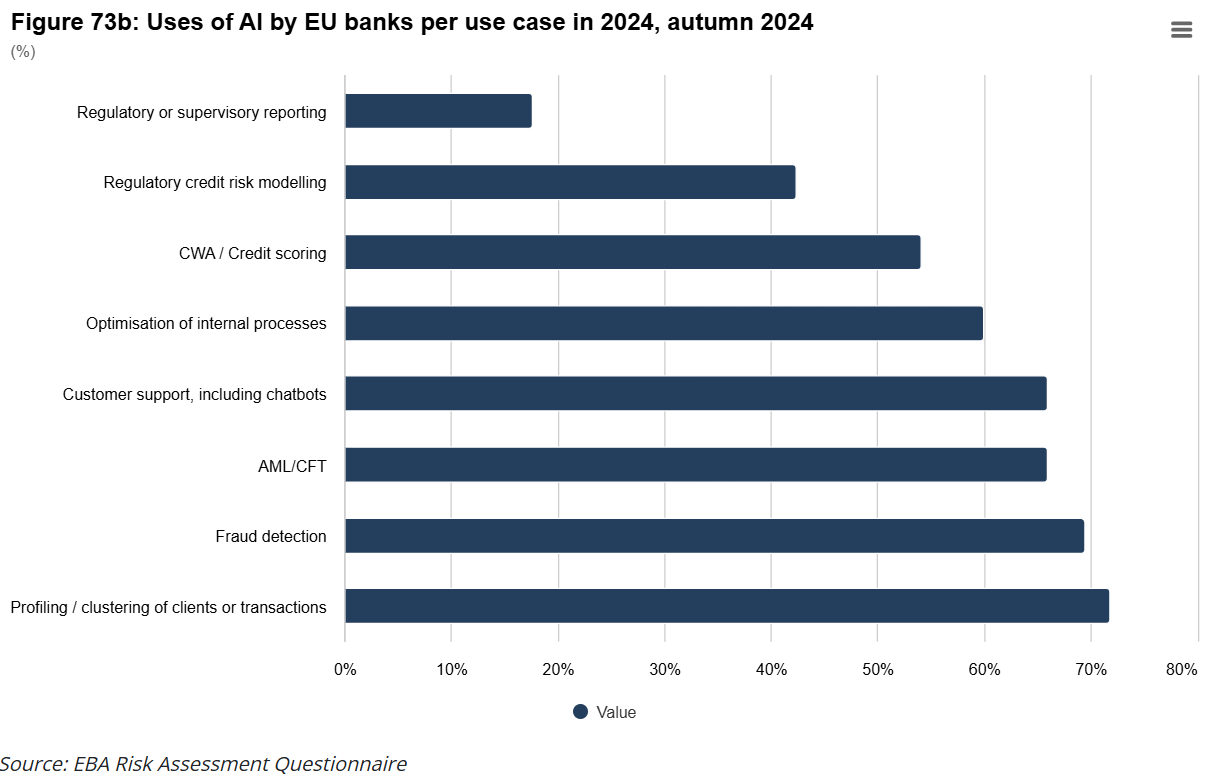
According to the EBA, the adoption of AI in European banking has spread widely in recent years, especially in areas such as customer segmentation, fraud detection, prevention of money laundering and terrorist financing or customer service.
How is AI applied in finance?
From a technology perspective, these solutions use machine learning models to detect patterns and anomalies, natural language processing techniques to interact with users, and predictive algorithms to estimate financial risks and trends.
AI has potential for use in the financial sector because it can recognize patterns and trends from large volumes of data. In the banking sector, it allows detecting fraudulent operations by analyzing millions of transactions in real time. Regarding the granting of credits, it helps to evaluate the solvency of clients through predictive models. And in the area of investment, automated investment models allow the automatic construction and rebalancing of portfolios adapted to the risk profile of each user.
The management of personal finances has also been transformed. Intelligent financial assistants and fintech apps use machine learning models to classify expenses, detect recurring subscriptions, project savings scenarios, and offer personalized recommendations. In this way, tasks that previously required specialized knowledge can be performed automatically and accessible.
What risks should we take into account?
The growing use of these systems also poses new challenges related to the transparency, security and reliability of the models, aspects that must be addressed to ensure the responsible use of artificial intelligence.
The challenge of understanding AI decisions
Machine learning models often operate as black boxes, meaning it is difficult to understand how they reach their conclusions. This lack of transparency makes it difficult to validate the results and poses challenges for both the adoption of these technologies and their regulation in financial environments.
In areas where decisions may affect assets, the granting of credit or risk assessment, it is essential to be able to justify and audit the results generated. To address this problem, the development of explanatory models is increasingly being promoted (Explainable AI or XAI), designed to offer a greater understanding of the factors that determine your results. This facilitates auditing of the systems and aligns with the European AI Regulation (AI Act).
The risk of bias in AI models
The quality of the recommendations generated by AI depends largely on the data with which the models are trained. If these data contain errors, biases or do not adequately represent reality, the conclusions drawn may also be incorrect. In the financial field, this can lead to inappropriate recommendations that harm users' assets. This concern has been recognized by the European AI Regulation, which requires that data used to train systems be relevant, representative and subject to bias detection and mitigation mechanisms.
Although the use of relevant and representative data helps improve the accuracy of the models, there will always be extraordinary events that escape the patterns observed during training. Therefore, data quality is a necessary condition for developing reliable models, but it does not guarantee the total absence of errors.
The security of financial data
Financial management powered by artificial intelligence requires access to sensitive information, such as banking transactions, income, investments or spending habits. Therefore, the platforms that use these systems must guarantee high standards of cybersecurity, confidentiality and privacy, in accordance with regulations such as the General Data Protection Regulation (GDPR) and the European Artificial Intelligence Regulation, which establish requirements regarding data governance, transparency and oversight of AI systems.
A security breach exposes user information that cybercriminals can exploit for financial fraud, identity theft, or the exposure of sensitive information about users' assets and financial habits. In this context, transparency in data processing and the ability to audit systems play a fundamental role in ensuring the safe and responsible use of artificial intelligence.
AI as a support, not a substitute
Relying solely on automated predictions without understanding economic or market fundamentals creates a false sense of security that increases the user's financial vulnerability. AI recommendations are based on patterns detected in the data, but its predictions are not infallible nor can they replace human judgment.
Therefore, it is important to understand that AI operates as an analytical co-pilot that amplifies the ability to process information, identify trends and evaluate alternatives, not as a system that never makes mistakes and acts autonomously. The combination of the user's vision and critical thinking complemented by the support of artificial intelligence allows us to mitigate risks and improve financial decision-making.
This approach coincides with the principle of human supervision included in the European AI Regulation, which considers it essential that people can understand, supervise and intervene in decisions assisted by artificial intelligence systems.
Dependence on a few technology providers
The development of the most advanced AI models is currently concentrated in a small number of technology providers. As a result, many financial applications depend on the same infrastructure to offer their services.
This situation generates dependency risks. A service interruption, changes in conditions of use or unexpected model updates can simultaneously affect multiple applications and financial entities. Additionally, each new release requires testing and monitoring processes to ensure that recommendations and functionality remain reliable and secure.
AI tools to manage personal finances
The current market mainly offers three types of tools for managing personal finances with AI, each with different degrees of automation, analytical depth and usability. Currently, general-purpose conversational systems, integrated continuous monitoring solutions and algorithmic models aimed at asset growth coexist.
The internal functioning, integration possibilities and limitations of each of these approaches are determining factors in selecting the most appropriate option and designing an effective financial management strategy.
Generalist Conversation Assistants
Based on large-scale language models (LLMs), they are the tool that we all imagine when talking about “AI”. Through a chat, you have a conversation with the model while you give him instructions (prompts). Conversational assistants are usually multimodal, that is, they are capable of processing information in different formats. They can analyze data from csv files or analyze bank statements, offering insights that we could only reach by applying data mining to draw the same conclusions. The most advanced and popular models are ChatGPT by OpenAI, Gemini by Google or Claude by Anthropic.
They are accessible models that have limited free use and extended use for a price of around 20 and up to 100 euros per month approximately. As limitations, they require manual supervision of input data and lack native real-time connectivity with banking entities.
As an example of application, I have shared with ChatGPT some synthetic expenses in csv format and I have asked him to analyze them and identify which ones are dispensable. Since this is an analysis, you have opened Work:
Once the response is validated, we continue and obtain the result:

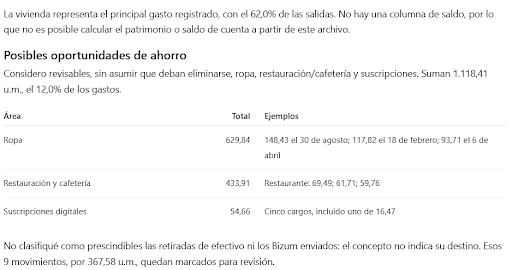
The result obtained has been useful: it has identified the largest source of expenses, it has indicated that 12% of the expenses are reviewable and it has shown them by category. This way it is clear where the money goes and you can see if defined limits are exceeded, for example, transforming data into savings opportunities.
Next I ask you to generate a graph that shows the evolution of the balance:
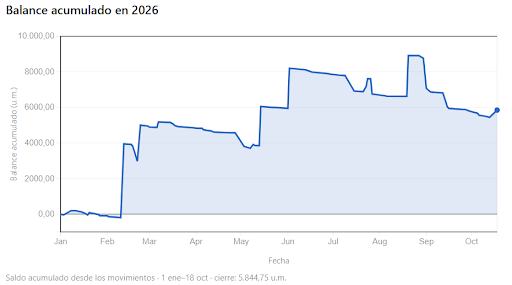
The graph allows you to visualize the evolution of assets over the last year and identify trends that could go unnoticed in a data table.
To see how it can help with your planning, I ask you to make a projection one year ahead to see how much you could save:
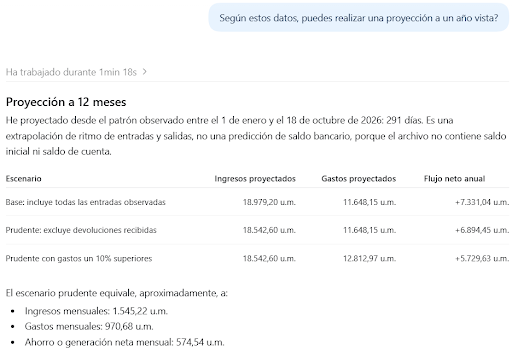
The model considers three scenarios, each one more conservative than the previous one, to make indicative estimates of the money flow.
By transforming financial movements into easily interpretable information, AI facilitates analysis, improves savings planning and provides relevant information to make better financial decisions. This case demonstrates how language models can interpret structured data, extract patterns, and generate user-comprehensible explanations.
FinTech Applications with Integrated AI
If we are looking for a centralized view of our finances, with tools capable of monitoring income, expenses and investments in real time, FinTech applications offer a greater degree of integration than general conversational assistants.
These platforms include built-in machine learning models to categorize transactions, generate alerts, detect spending patterns, and project cash flow trends. Furthermore, thanks to the banking integration through APIs of Open Banking, have automated transaction recording and financial data analysis tools. This reduces the effort necessary to keep the view of the economic situation up to date.
Some fintech applications are Monarch Money, Copilot or Cleo in the US/UK, and Finch in Europe. There are also integrated solutions in neobanks and traditional entities such as BBVA with its assistant Blue or Revolut with its version AIR. Additionally, they often combine free features with subscription plans that expand analysis and automation capabilities.

Its main value lies in the automation of tasks and the centralization of information. Their financial orientation is clear, although they usually offer less flexibility compared to generalist tools based on LLMs, as they depend on previously defined interfaces, workflows and functionalities. However, the interaction is quite similar, only in this type of applications the AI is used transparently to the user; It is implicit in transaction categorization and personalized recommendations.
Automated Investment Managers (Robo-advisors)
They are algorithmic models aimed at the design, execution and automated rebalancing of diversified investment portfolios according to the risk profile. They stand out for their reduced commissions, the reduction of emotional biases in market decision-making and accessibility with low initial capital.
Its greatest disadvantage is operational rigidity in the face of unforeseen financial situations that go beyond the parameters learned during training, since past performance and forecasts are not reliable indicators of future results.
How to start using AI to manage finances
The key is not to completely delegate financial decisions, but to use AI as a tool that expands our analytical capacity and helps us make more informed decisions.
- Register movements: Centralize the information of your accounts, cards and investments. You can do this by uploading bank statements to a model's chat or using banking-connected apps that automate the task. Then, you can organize your expenses by category to see what you spend on. A global vision of your movements makes it easier to carry out reliable financial analysis.
- Perform an analysis of your financial situation: Ask the AI to generate a report on your income, expenses, assets and spending habits. Use this analysis to identify savings opportunities, spot spending trends, and answer questions like, “How long would it take to save a certain amount?” In fintech applications, much of this process is done automatically through models that identify recurring expenses, subscriptions, and consumption patterns.
- Define objectives: Once you have analyzed your financial situation, establish realistic savings goals in accordance with your financial capabilities. Intelligent financial assistants can help you plan these goals and monitor their fulfillment.
- Evaluate personalized investment options: After optimizing and automating savings, you can explore robo-advisor-type tools that adapt to your objectives, time horizon, and risk tolerance.
As a guide when choosing which tools powered by artificial intelligence best suit your needs, a table with information of interest is shown:
| Solution | Financial record | Data analysis |
|---|---|---|
| GPT Chat(Multimodal LLM) | Manual with files/images;Allows you to centralize data from multiple accounts | Conversational interaction and personalized analysis |
| Finch(AI-powered fintech app) | Automatic with linked accounts; manual with files/images; Allows you to centralize multiple accounts | Integrated in the interface and conversational through Finch Agent (Gemini) |
| Revolut (Neobank and fintech) | Automatic; Only works with data from Revolut accounts | Integrated into the interface and conversational through AIR (specialized finance model) |
Conclusion
Financial applications with AI and banking integration offer a complete and simple solution to optimize savings and maintain control: banking integration allows real-time monitoring, and applied AI offers advice, projections and answers queries like a financial advisor. This improves accessibility and inclusivity for people with less financial knowledge. Likewise, robo-advisors train people to invest automatically.
The different applications of AI in finance bring financial control closer to people, something that was previously only learned through experience. Having integrated intelligent tools within reach that facilitate this task generates a positive impact on personal finances, allowing financial education to go from being exclusive to being accessible.
AI applied to finances helps us reduce unnecessary expenses, improving our savings capacity and also helps us invest to generate profits. However, the models are not perfect, the recommendations and forecasts are not free of errors. Therefore, the best strategy is to use AI as a support tool that complements our judgment and, when necessary, specialized professional advice.
The true AI revolution in personal finance is not about delegating our decisions to a machine, but about having tools that help us better understand our money and make more informed decisions.
A story from the Saturdays.AI community. Originally published on Nov 9, 2026.
← More community stories