Nutrition in the digital age: how AI is transforming clinical practice
From estimating food intake to precision nutrition: AI applications, research directions and the challenges of bringing them into clinical practice.
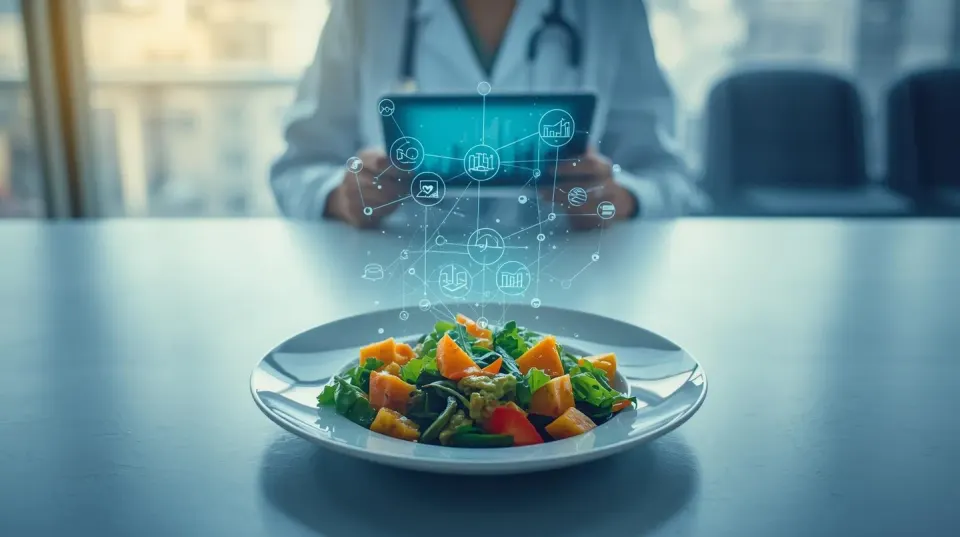
Imagine Juan, a hospital patient, being served a meal. A healthcare professional photographs his tray with a smartphone, and an application estimates the foods, quantities and nutrients it contains. A second image after the meal helps estimate how much he has eaten. The team can combine these data with a clinical assessment to evaluate his nutritional status.
Can a machine help us understand how we eat and identify nutritional problems? Artificial intelligence (AI) offers tools to explore this question. Healthcare centres and laboratories are developing and evaluating applications to analyse diet, support personalised interventions and investigate diet-related diseases.
From algorithms that process large datasets to devices that monitor food intake, AI is opening up possibilities for more personalised nutrition. This article explores some of the areas in which it is changing clinical practice and research.
How AI can help measure what we eat
Knowing precisely what and how much we eat is one of the great challenges in nutrition. Dietary records depend partly on memory and on how people describe their meals. AI can complement these methods, although its estimates also need validation.
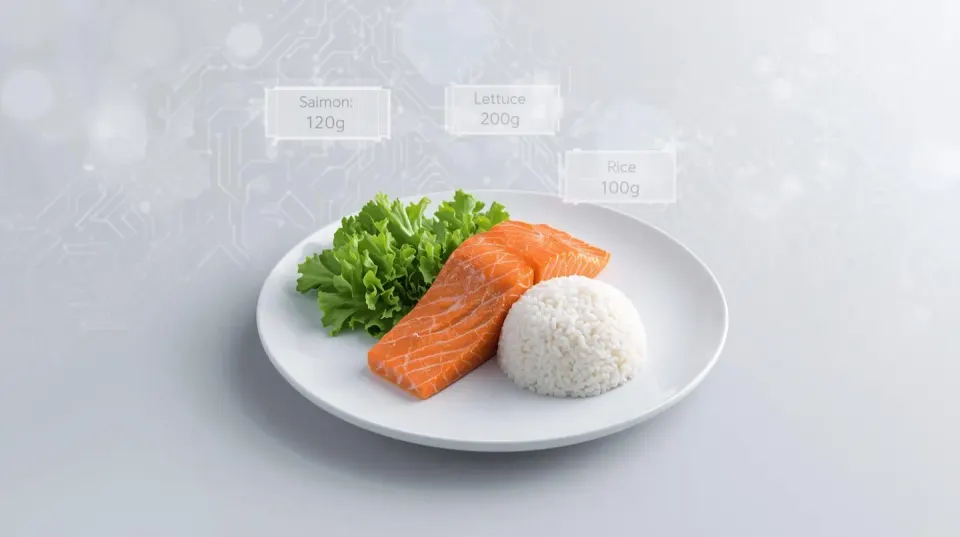
Computer vision can estimate foods and portion sizes from images. For example, the goFOOD system uses two images or a short video to recognise foods, estimate their volume and calculate their energy and macronutrient content. Image quality and the foods the system can recognise affect the result.

Some hospitals use systems that compare a patient’s meal tray before and after a meal to estimate intake. Researchers are also exploring technologies that use acoustic sensors or jaw-movement sensors to study when and how a person eats.
These tools can provide nutrition professionals with additional information to tailor dietary plans to each patient. Their usefulness depends on data quality and on how each system has been evaluated.
AI in disease prevention and nutritional risks
Diet affects more than body weight: it also plays a role in disease risk. One promising area for AI in nutrition is helping professionals identify risks earlier and support prevention.
We find an example in the study of the intestinal microbiota, the community of microorganisms living in our gut that contributes to our health. Algorithms can analyse DNA sequence data and explore associations with diet, obesity or inflammatory bowel disease. Finding an association does not, on its own, establish that a disease can be predicted before symptoms appear.
Hospitals and care homes are exploring how to combine weight, food intake, laboratory results and clinical records to identify nutritional risk. For example, AI models show promise in identifying malnutrition risk. Integrating them into care requires standardised data, clinical validation and evaluation of their actual benefits.
Even in imaging tests such as computed tomography, deep learning can help quantify muscle mass and detect changes. This information can support nutritional assessment, although identifying a problem does not itself guarantee that complications will be prevented.
Diet therapy and clinical nutrition with the help of AI
When we talk about nutrition in a clinical setting, every detail matters. The amount of carbohydrates, proteins or micronutrients could make the difference in a patient's outcome. And this is where AI begins to play an important role: it does not replace the healthcare professional, but it can be an ally to design more precise and personalized interventions.
Diabetes provides another example: computer vision systems can help estimate the carbohydrates in a meal from images. These estimates can support meal planning, but do not replace advice from the healthcare team. Some systems also integrate biomarkers in real time, such as glucose levels, to tailor dietary recommendations to the person’s physiological state.
Researchers have also developed chatbots for people with cancer, offering dietary information during treatment. These should serve as informational support, with supervision and referral to the healthcare team when needed.

Hospital nutrition research is also exploring machine learning models to support decisions about enteral or parenteral nutritional support formulas, using clinical data. This does not mean that automatic, real-time adjustment is routine practice: decisions remain the responsibility of the healthcare team.
AI can support nutritional decision-making, but it does not replace healthcare professionals’ expertise. Its value needs to be evaluated in the clinical setting in which it is used.
Nutrition research: the role of AI
AI is also expanding the tools available for nutrition research. It can help explore large datasets and generate hypotheses that must then be tested through appropriate studies.
In epidemiological studies, for example, it can analyse data from thousands of people to explore associations between diet and health, complementing established statistical methods.
Another application is unsupervised learning, which groups people by dietary patterns. This means that consumer (or patient) profiles can be created and dietary strategies explored for each group. Their effectiveness needs to be assessed in subsequent studies.
One especially promising area is precision nutrition, in which AI integrates data from biomarkers, food intake records and anthropometric measurements such as weight, height and body composition. This approach is still developing, but may help tailor future interventions to specific genetic or metabolic profiles.
An evolving field
Let us return to Juan’s example. Images of his tray could give the healthcare team information to adjust his diet and monitor his progress. That record would be one part of an assessment that also considers his illness, needs and preferences.
AI already has applications in nutrition, while many others remain under investigation. They range from automating food intake records to analysing complex data to explore personalised interventions and new scientific questions.
The challenge in the coming years will be to integrate the analysis capacity of AI with the experience and judgment of health professionals, without forgetting the cultural, social and human dimension that characterizes food. Are we prepared?
A story from the Saturdays.AI community. Originally published on Oct 8, 2025.
← More community stories