AI and pregnancy: estimating gestational age from ultrasound
A study explores combining automated fetal-brain analysis with biometric measurements to estimate gestational age.
Gestational age indicates how far a pregnancy has progressed and helps guide prenatal care. Crown-rump length is commonly used in the first trimester; later measurements include biparietal diameter, head circumference and femur length. Estimation becomes less precise as pregnancy advances.
The cited study explores whether automated analysis of fetal-brain ultrasound can complement standard biometric measurements. It uses transthalamic axial-plane images and compares the estimates with formulas used in clinical practice.
The method, known as quantusGA, was developed using deep learning and images from 1,394 patients. Specialist annotations helped locate and orient the fetal brain in the images.
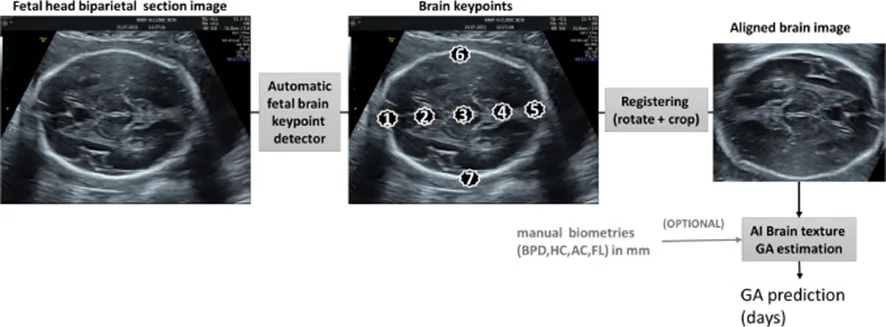
The illustration outlines how quantusGA works.
The system takes a DICOM ultrasound image of the fetal brain and produces an automated gestational-age estimate expressed in days.
The original project description reports an implementation in Python. The processing locates and orients the fetal skull, crops the region of interest, and analyses brain texture and size to estimate gestational age.
Evaluation focused on the second and third trimesters, not the second and third months. Combining AI with biometry produced similar or lower errors than biometry alone, especially in the third trimester. These findings support further research; they do not imply that any AI system improves every fetal diagnosis.
Gestational age informs decisions about delivery and care before and after birth. A more accurate estimate could support clinical teams, especially when an early ultrasound is unavailable. This method aims to complement the available information. Its usefulness and generalisability need evaluation in other settings before broader clinical benefits can be claimed.
Possible areas for future evaluation include:
- Support for prenatal monitoring
- Clearer communication of uncertainty in the estimate
- Assessment of maternal and fetal outcomes, which this study does not establish as improved
- Validation across different populations and ultrasound equipment
Bibliography:
Xavier P Burgos-Artizzu, David Coronado-Gutiérrez, Brenda Valenzuela-Alcaraz, Kilian Vellvé, Elisenda Eixarch, Fatima Crispi, Elisenda Bonet-Carne, Mar Bennasar, Eduard Gratacos. Analysis of maturation features in fetal brain ultrasound via artificial intelligence for the estimation of gestational age. Am J Obstet Gynecol MFM. 2021;3(6):100462. Published online 14 August 2021. DOI: 10.1016/j.ajogmf.2021.100462.
Written by
Eva Arnall

Saturdays.AI
Saturdays.AI is an open community for learning artificial intelligence, collaborating and building projects with social impact.
A story from the Saturdays.AI community. Originally published on March 9, 2022.
← More community stories