Llama 3.2: A New Standard in Artificial Intelligence
Released by Meta in 2024, Llama 3.2 combines lightweight text models with vision variants. We look at its capabilities and the limits of its evaluations.
In September 2024, Meta introduced Llama 3.2, a family with two main branches: lightweight text models and models that can work with images. It expanded development options, from compatible devices to servers. This article looks back at the launch and what it offered at the time.
A More Powerful and Versatile Model
The 1B and 3B text variants use an autoregressive transformer architecture. Meta reports pretraining on up to 9 trillion tokens. They officially support eight languages, including Spanish and English, and quality can vary by language and task.
Grouped-Query Attention (GQA) improves inference efficiency. Instruction-tuned versions use techniques including Supervised Fine-Tuning (SFT) and Direct Preference Optimization (DPO). These design choices support performance, but do not guarantee accuracy in every use case.
Innovations that Make a Difference
The family offers options for different needs. These are some of the features Meta highlighted at launch:
- Edge Device Capabilities: Imagine having the power of an advanced AI model in the palm of your hand. Llama 3.2, in its versions 1B and 3B, supports tasks such as summarising and rewriting text on compatible devices. Feasibility and speed depend on hardware, memory and optimisation.
- Advanced vision models: But we don't just talk about text. Llama 3.2 incorporates models of 11B and 90B parameters for text-and-image tasks. Meta reported competitive results on selected visual-understanding benchmarks; that does not establish superiority over every alternative in every use case.
- Ease of development: Meta has launched Llama Stack, a platform that simplifies the development process with Llama models. With a common API to work in multiple environments and programming languages such as Python, Node.js, Kotlin and Swift, developers can now build applications faster and easier, no matter where they deploy their models: whether in the cloud, on-premises environments, or on edge devices.
An Open Ecosystem for All
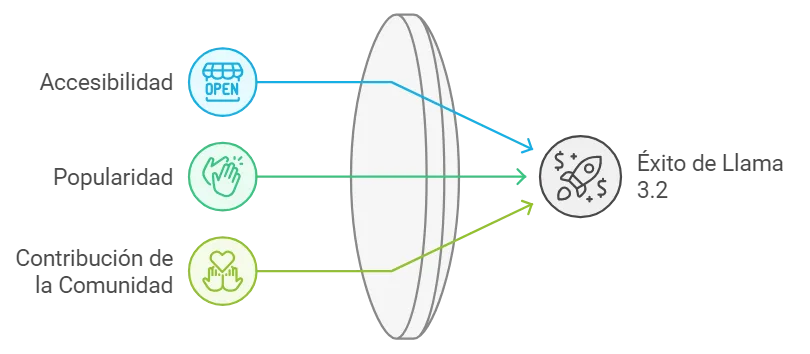
Meta distributed the models through its Llama website, Hugging Face and infrastructure providers. Access to model weights supports experimentation and deployment, but use remains subject to the Llama licence and its terms, which may vary by model type and region.
The Llama community develops adaptations, tools and applications. Its activity broadens the family’s uses; download figures are time-specific and depend on what is being counted, rather than directly measuring quality.
Llama 3.2 Under the Microscope: Evaluations and Results
Llama 3.2 was evaluated using automated benchmarks and human evaluations covering tasks such as summarisation, instruction following and dialogue. These tests compare specific aspects of performance, but Llama 3.2 must also be tested against each application’s data, languages and requirements.
The published evaluations offer useful evidence about the family’s capabilities and limitations. They do not establish that Llama 3.2 will perform equally well in every real-world setting.
The Future of AI: Secure, Open and Multilingual
With the launch of Llama 3.2, Meta expanded its range of models with available weights. Responsible use requires considering capabilities alongside AI safety and security and the accessibility, together with privacy, licence terms and application-specific evaluation.
The availability of models such as Llama 3.2 creates more opportunities to learn, experiment and build. The next step is to choose an appropriate variant, test its limits and check whether it meets the needs of the problem at hand.
Are you ready to join the Llama revolution?
A story from the Saturdays.AI community. Originally published on Nov 16, 2024.
← More community stories