How to use AlphaFold 2 with ColabFold in Google Colab
An introduction to AlphaFold 2 with ColabFold: sequences, running Google Colab, visualisation and interpreting model confidence and limitations.
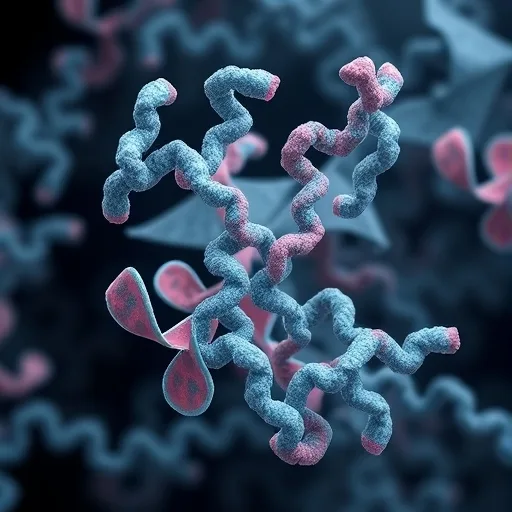
Proteins are the molecular machines that make life work, and their three-dimensional structure helps us understand functions such as catalysing reactions or transmitting signals. Proteins can also change shape or contain disordered regions; they do not all function as one rigid structure.
When a protein has defects in its shape, diseases can arise. For example, in cystic fibrosis, a small change in the amino acid sequence causes incorrect folding, which disrupts the function of lung cells. These types of structural problems are also behind neurodegenerative diseases such as Alzheimer's or certain types of cancer.
Knowing the shape of a protein allows scientists to understand its function, design drugs that interact with it, and find solutions to health problems. This is where it comes in AlphaFold, a tool that predicts structures and can accelerate research. A computational prediction is not equivalent to an experimentally determined structure and does not replace all laboratory work.
Why Knowing 3D Structure Is Crucial
A protein’s structure is related to its function. Some changes can affect that function, although not every change is harmful. For example:
- Molecular interaction: enzymes have regions that interact with their substrates.
- Cell signaling: Proteins like hormone receptors must have exact shapes to receive signals.
- Incorrect folding: Mutations in the amino acid sequence can lead to diseases, as seen in certain forms of cancer and genetic disorders.
How AlphaFold Changes the Rules of the Game
AlphaFold, developed by DeepMind, uses neural networks to predict structures from amino-acid sequences. This article focuses on AlphaFold 2 through ColabFold, which can generate three-dimensional protein models, with runtimes that depend on the sequence, model and available resources.
But it's not just for AI experts. Anyone from students to experienced scientists can use AlphaFold through platforms like Google Colab, making this technology more accessible than ever.
How to Use AlphaFold in Google Colab
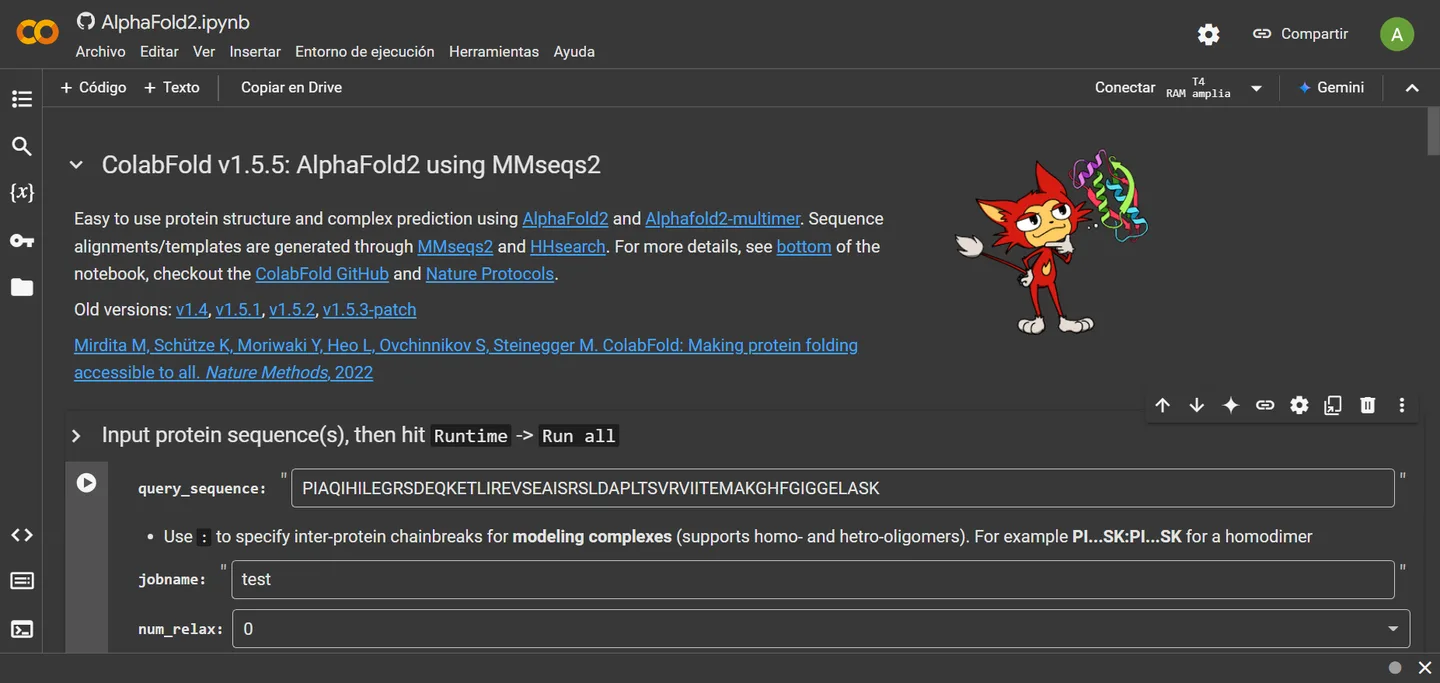
ColabFold provides a guided notebook, though execution depends on software versions and available Google Colab resources. The general workflow is:
- Open the tool:
Open the ColabFold notebook, a project that makes structure-prediction models, including AlphaFold 2, easier to run. - Enter your protein sequence:
Use the one-letter code for amino acids (e.g.MKTAYIAKQRQISFVKSHFSRQ) and paste it in the indicated place. These sequences are easily found in databases such as UniProt. - Run the code:
Configure the runtime and execute the cells following the notebook’s instructions. Download the structure files and confidence outputs, such as pLDDT and PAE where available. A confidence score is not experimental validation. - View the model:
Download the .pdb file and open it in a program like ChimeraX, which allows you to explore the three-dimensional structure in detail.
AlphaFold Applications: From Medicines to Synthetic Biology
AlphaFold is not just a tool for predicting structures, but a catalyst for solving complex problems. Some notable uses include:
- Drug discovery:
Predicted structures can provide a starting point for studying potential binding sites and running simulations with other tools. The example mentioned in the original version was the enzyme HDAC11. Such simulations generate hypotheses; they do not establish that an inhibitor is effective or safe as a treatment. - Studying disease:
Structural models can support research into disease-associated proteins. However, AlphaFold 2 has not been generally validated for predicting mutation effects or reproducing the process of misfolding. - Synthetic biology:
Structure predictions help assess candidates designed with other tools, such as enzymes. AlphaFold 2 predicts structures from sequences; it does not by itself design a protein with a desired function.
The Future with AlphaFold
Limitations depend on the version. AlphaFold 2, discussed here, does not by itself model small molecules bound to a protein or describe its full dynamics. Some regions also have low confidence. Predictions therefore need to be interpreted alongside quality indicators and checked against experimental evidence.
AlphaFold is not just a breakthrough in artificial intelligence; It is a tool that is accelerating progress in biology, medicine and beyond. If you're interested in exploring its potential, now is the time to start!
A story from the Saturdays.AI community. Originally published on December 10, 2024.
← More community stories