The AI Revolution in Science: Nobel Prize in Physics 2024
Why Hopfield and Hinton received the 2024 Nobel Prize in Physics: associative memory, Boltzmann machines and the link between physics and machine learning.
The 2024 Nobel Prize in Physics recognised John J. Hopfield and Geoffrey E. Hinton for foundational contributions enabling machine learning with artificial neural networks. The key connection is that they used tools from physics to develop those methods.
What did Hopfield and Hinton contribute? Their work helped establish foundations of machine learning, connecting networks of artificial units with ideas from energy, memory and statistical physics.
From the human mind to artificial intelligence
In 1982, John J. Hopfield introduced an associative-memory model capable of storing and retrieving patterns. Known as the Hopfield network, it uses an energy function to describe how the network evolves towards stable states. It is not a complete description of how the brain works.
On the other hand, Geoffrey E. Hinton, considered one of the fathers of deep learning, developed key tools to train artificial neural networks. These networks, inspired by the human brain, are now the basis for many technological advances, from virtual assistants to medical diagnostic systems.
The connection to physics is central: Hopfield used ideas from spin systems, while Hinton contributed to the Boltzmann machine, based on concepts from statistical physics.
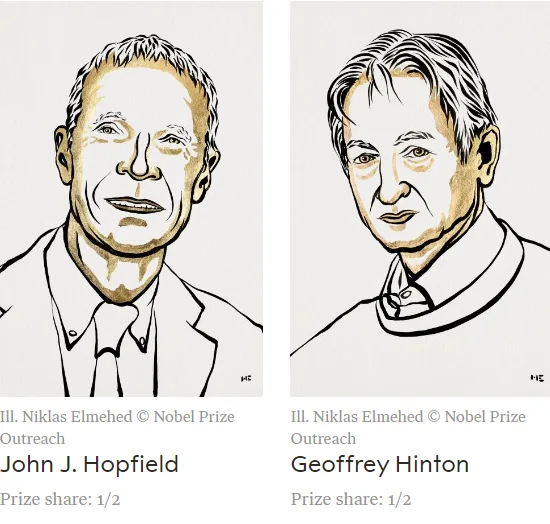
Obtained from the official Nobel website
Why a Physics Prize for an Area of Mathematics and Computer Science?
The award may seem surprising if we focus only on today’s AI applications. Its official rationale, however, highlights the use of tools from physics to build models of memory and learning. The connection runs both ways: neural networks are also used to study physical systems and materials.
Physics and AI: a winning combination
Why are these advances in AI so important for physics? The answer lies in the ability of neural networks to find patterns in large amounts of data.
Modern physics faces incredibly complex problems, such as understanding how subatomic particles interact or how large-scale structures in the universe form. Traditional methods are not always sufficient to address these challenges. This is where the tools developed by Hopfield and Hinton made a difference.
Artificial neural networks have allowed:
- Model quantum systems: Predict how particles behave at tiny scales.
- Explore dark matter: Analyze astronomical data to better understand the composition of the cosmos.
- Optimize physics simulations: Reduce the time needed to solve complex equations.
Fundamental discoveries and inventions
Machine learning built on these and other contributions is also used in medicine, engineering and sustainability. These are applications of a broad field, not results attributable exclusively to the two laureates. Research areas include:
- medical diagnosis: Identification of patterns in images to detect diseases.
- Renewable energy: Optimization of solar panels and advanced batteries.
- Smart materials: Creation of new compounds for industrial applications.
This Nobel not only celebrates technical advances, but also the profound impact they have on society.
The importance of the 2024 Nobel Prize in Physics
The Royal Swedish Academy of Sciences highlighted how Hopfield and Hinton's work represents a new era in science, where mathematics, physics and computing converge to solve problems in an interdisciplinary way. This recognition underscores that AI tools are not just technological; They are also essential for exploring the fundamental laws of the universe.
What's next?
These tools will continue to create possibilities and raise questions. Progress depends on data, models, evaluation and scientific judgement, while also addressing risks and limitations. The prize highlights the value of ideas that cross disciplines.
To explore another connection between AI and science, read our article on AlphaFold, whose development contributed to work recognised with part of the 2024 Nobel Prize in Chemistry. Find it here.
A story from the Saturdays.AI community. Originally published on December 12, 2024.
← More community stories